Our Trainers
ETR's exceptional cadre of professional trainers consists of experts in professional learning, health education, and HIV, STD and pregnancy prevention. In addition to our on-staff trainers featured below, we work with a network of skilled professional development consultants throughout the United States.

Lia Cassanego, MPH
Lia Cassanego is the Training Coordinator / Trainer at ETR. In this role, she coordinates the intake and delivery of capacity-building events, both in-person and online. Previously, Ms. Cassanego worked at CAI, a New York City Based capacity-building organization. As the Sexual and Reproductive Health Capacity Building Specialist/Project Manager at CAI, she was involved in the development of sexual and reproductive health (SRH) training curricula and materials, provided technical assistance and was a trainer on CAI's SRH trainings.
Ms. Cassanego has been working in the field of sexual and reproductive health for almost a decade in school and health settings. She began her work with adolescents as a Planned Parenthood volunteer, providing health education and mentorship to teenage mothers in the Watts neighborhood of Los Angeles, California. This experience propelled her to seek out opportunities to engage with adolescents in a school setting. As part of AmeriCorps, Ms. Cassanego served as an academic coach and mentor to struggling and at-risk youth in a low-income high school. During this time, she drew on adolescent development theory to best support her students in navigating this unique developmental stage in a difficult environment.
Following her service in AmeriCorps, Ms. Cassanego moved into the health arena. As the Women’s Health Advocate at a Federally Qualified Health Center (FQHC), Ms. Cassanego developed client education materials on contraceptive methods, assisted in the implementation of two family planning–related research studies conducted by UCSF Bixby Center for Global Reproductive Health and Gynuity Health Projects, as well as acted as a support doula to women and adolescents undergoing reproductive health procedures.
Ms. Cassanego has a BA from UCLA and a Masters of Public Health with a certificate in Sexuality, Sexual and Reproductive Health from Columbia University’s Mailman School of Public Health.
Debra Christopher, MSM
Debra Christopher, Specialist, Design for Learning, leads a strategic initiative to establish ETR as the national leader for research-based instructional practices—those that are current, innovative, learner centered and pedagogically sound, and that result in the transfer of learning. She is a nationally recognized professional development consultant, specializing in instructional design, training and facilitation skills, and the neuroscience link to learning.
Previously, Deb served as the director of the Professional Development Partnership (PDP), a 9-year national initiative funded by the federal Centers for Disease Control and Prevention. In that role, she led a national team that worked with over 200 leaders from state and local education agencies and non-governmental national organizations to strengthen their capacity to provide quality, evidence-based prevention programs to youth. She has also worked as a health educator/prevention specialist in the Colorado departments of health and education and is a former middle and high school health education teacher.
She earned her BA degree in health education from the University of Northern Colorado and an MSM degree in business management/organizational development from Regis University. She is also a graduate of the National Staff Development Council Academy, a member of the national Brain Matters Leadership Group, and is certified in conducting the MBTI personality inventory.


Kelly Gainor, MEd
Kelly Jean Gainor is the Training Manager for ETR, focusing on the development and implementation of virtual TOEs. Prior to working at ETR, Kelly has worked at several non-profit organizations delivering evidence-based education directly to youth, training and providing professional development for educators and youth-serving professionals and writing/designing lesson plans for group of all ages, orientations and identities.
Kelly has been working in the field of sexuality education and training for nearly a decade. She began her career volunteering and working for Planned Parenthood, where she provided evidence-based sexuality education. She also was the coordinator for an LGBTQ youth group as part of her role. In addition to education, Kelly has provided training to youth-serving professionals and presented at several national conferences, including the National Sex Ed Conference. Following her work at Planned Parenthood, Kelly worked for a small nonprofit organization in Central PA, overseeing several Personal Responsibility Education Program (PREP) grants and other adolescent health initiatives.
Kelly attended Cornell University for her undergraduate work in Communications, then enrolled at Widener University where she received her Master’s degree in Human Sexuality Education in 2012. Since then, she has focused primarily on HIV prevention education throughout her professional career. Her favorite topics to teach and train about include body image and LGBTQ+ education.
In 2020, Kelly had 4 lesson plans published in the teaching manual Orientation: Teaching about Identity, Attraction and Behavior.
Gina Lepore, MEd
Gina Lepore, MEd. serves a Project Coordinator and Trainer with extensive experience in reproductive and sexual health and sexuality education. She currently serves as a trainer and TA provider for numerous community-based agencies through the MCAH Statewide TPP Training and Evaluation Project, and as a trainer and coordinator for ETR’s K12T9 Initiative Team.
Gina’s special interests include affirmative consent, sex-positivity, and diversity and inclusivity, especially in K-12 and college level sexuality education programming and curricula. She recently co-authored the ETR supplement Teaching Affirmative Consent and has designed trainings on this content for K-12 Title IX Coordinators, school administrators and teachers, and community-based educators. In her tenure at ETR, she has served in various capacities (researcher, project coordinator, data collection coordinator, curriculum developer, trainer) on numerous multi-year program evaluation, technical assistance and research projects.
When not at ETR, she moonlights as an Adjunct Lecturer of Human Sexuality at Cabrillo Community College, a sexual health trainer for various medical schools in the Bay Area and freelance community-based sexuality educator. She is semi-fluent in both Spanish and Portuguese and holds a Master of Education in Human Sexuality from Widener University and a Bachelor of Arts in Psychology from the University of California, Santa Cruz.

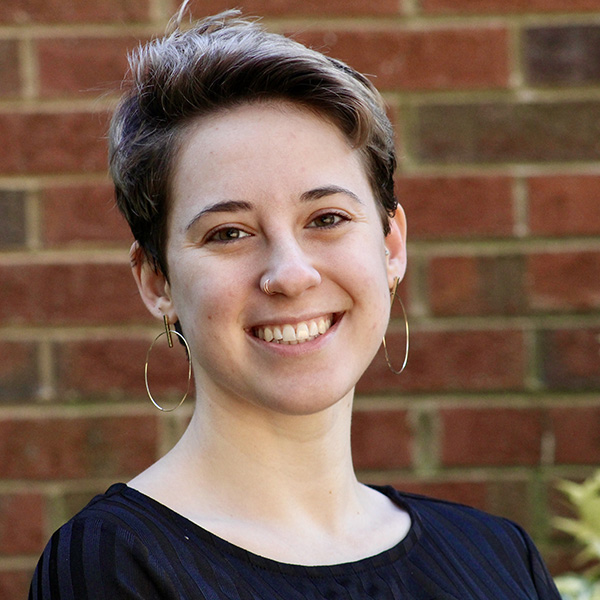
Kelley Quinn, MEd
Kelley Quinn is a Project Coordinator for the Professional Learning Support training services. She is the first point of contact for clients related to training and ETR's sexual and reproductive health (SRH) education programs. She manages all logistical tasks leading up to and during the delivery of the training events. She also contributes to the development of training and SRH support material.
Kelley's educational interests are in consent education, bystander intervention and prevention work, and discussions on intersections of privilege--particularly in queer spaces. She is committed to the continuous journey of learning and unlearning and believes that she is as much an educator as a learner in her field.
She strives to empower students and colleagues in resisting oppression and revolutionizing their environment and their body. She believes every classroom has the potential to be a place of social change and aspires to make every educational opportunity one of revolution.
Kelley earned her Master of Education in Human Sexuality from Widener University and her Bachelor of Arts in English and Gender & Sexuality from Georgia College & State University.