Becoming a Responsible Teen
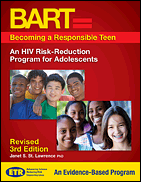 Becoming a Responsible Teen (BART) is an 8-session community-based HIV-prevention program. BART helps teens clarify their own values about sexual activity, make decisions that will help them avoid becoming infected with HIV, and learn skills to put their decisions into action. Although not specifically pregnancy prevention oriented, many of the communication and condom skills taught in BART will also help students avoid unintended pregnancy.
| Category | Program Features |
|---|---|
| Setting | Community based |
| Program Length | 12–16 hours/year | 1 year 8 sessions total |
| AgeGroup | Ages 14–18 |
| Look Inside |
Find out what's new in the Revised Third Edition >>
Overview | Description | Population | Author | Who's Using
Overview
Becoming a Responsible Teen (BART) is an 8-session community-based HIV-prevention program. BART helps teens clarify their own values about sexual activity, make decisions that will help them avoid becoming infected with HIV, and learn skills to put their decisions into action. Although not specifically pregnancy prevention oriented, many the communication and condom skills taught in BART will also help students avoid unintended pregnancy.
Description
BART was designed as an HIV risk-reduction program for African-American teens ages 14 to 18. The program is intended for use in non-school settings, such as youth-serving organizations and other community-based organizations. Designed to reduce risky sexual behaviors and improve safer sex skills, the sessions provide information on HIV and related risk behaviors and the importance of abstinence. Although designed as an HIV/AIDS prevention program, BART also includes information on pregnancy prevention.
BART is especially suited for use in non-school settings such as Boys’ and Girls’ Clubs, YMCA programs, drug rehabilitation programs, shelters, counseling and health centers, and church groups. Through a variety of methods, including interactive group discussions, demonstrations, roleplays, culturally appropriate videos and first-hand interactions with people with HIV from the participants’ community, participants learn:
- Essential information about HIV and AIDS
- Ways to handle social and sexual pressures
- Ways to communicate assertively with friends and potential sexual partners
- Refusal skills
- Negotiation skills
- Condom use skills
Population Served & Setting
The BART program was originally designed to be used with African-American adolescents ages 14 to 18 and to build their sense of ethnic pride. In general, the information about HIV and the skill-building activities taught in BART are appropriate for all adolescents, though some handouts and discussions are tailored to African-American participants. Program leaders are encouraged to build on the ethnic pride foundation when adapting the activities to reflect the concerns and cultures of the groups of youth they serve.
About the Author
Janet S. St. Lawrence, MS, PhD, served as Chief for the Behavioral Interventions and Research Branch in the Division of STD Prevention at the Centers for Disease Control and Prevention. She also has been a professor of psychology at Jackson State University and director of the Community Health Program in Jackson, Mississippi. She is a Professor Emerita at Mississippi State University.
She is currently in the Department of Psychology at Portland State University, and has received numerous honors and recognitions. She served two appointments, each for 4 years on Study Sections at the National Institutes of Health. She is the author of 7 books and more than 200 publications applying psychology to health and social problems based on her domestic and international research.
Who’s Using?
ETR's effective, award-winning, evidence-based resources are used by schools, departments of education, youth groups, government agencies and clinics nationwide.
Some of the sites that have purchased Becoming a Responsible Teen include:
- Karuk Tribe of California
- Navajo Nation, Arizona
- OIC of Broward, Florida
- Creative Visions Social Services, Texas
- Planned Parenthood of Illinois
- Women Accepting Responsibility, Maryland
- City of Alexandria, Virginia
- University of Nevada, Las Vegas
- Georgia Campaign for Adolescent Power and Potential
- OIC of America, Pennsylvania
Length | Elements | Staffing | Notification
Length of Program
The program consists of 8 sessions, 1 session per week for 8 weeks. Each session is 90 minutes to 2 hours long.
Program Elements
The BART Basic Set includes include a leader's guide, student workbooks for one classroom of 30 students, and the Scenarios USA DVDs The Monster and Shortest of the Shorts.
Student workbooks are required for every student. Additional classroom workbook sets of 5 and 30 are available.
An optional LGBTQ Supplement helps teachers build a supportive environment for LBGTQ students. It includes a lesson that can be taught before implementing the intervention as well as suggestions for acceptable adaptations to make program activities more inclusive of LGBTQ youth.
An enhanced set of materials is also available that includes supplemental materials to augment student learning, including DVDs, pamphlets and posters. The enhanced set includes the LGBTQ Supplement.
ETR also provides free downloads of pre- and post-tests and Adaptation Tools.
Staffing Requirements
Two co-leaders are recommended for leading BART with each group of youth, ideally one male and one female. Groups may be separated by gender for the skill-development activities. Educators interested in implementing this program should be skilled in using interactive teaching methods and guiding group discussions, and should be comfortable with the program content. Above all, they should be people the youth trust and feel comfortable with.
Parent/Guardian Notification
It is essential to inform parents and guardians regarding the nature and scheduling of this or any sexual health education program. Prior to implementation of the curriculum, families should receive written notice describing the goals of BART and the nature of the content to be covered. Parents also should be given an opportunity to view the curriculum and related materials if they wish. The vast majority of parents want their children to receive appropriate instruction and be given the information and skills they need to protect their sexual health, but parents/guardians also must be allowed the chance to opt out or exclude their children from participating in the program, if they wish.
Theory | Logic Model | Evidence Summary | References
Theory
BART incorporates Social Learning Theory and Self-Efficacy Theory. The curriculum includes 4 major components designed to reflect these theories:
- Information that increases adolescents’ knowledge and their awareness of risk.
- Training in the skills adolescents need to translate the information into action.
- Opportunities to practice and receive corrective feedback, using the skills in a safe environment before they face the challenges of using them in risky situations.
- Social support for the desired behaviors, to help make them the norm in social environment.
Logic Model
The program logic model can be found here:
Logic Model (pdf)
Evidence Summary
Research Design
In the original study, 246 adolescents were randomly assigned to either a control condition or the experimental intervention (BART). The control condition consisted of a single, 2-hour education session that provided information about HIV, including prevention and its impact on the local community. The first session of BART was identical to the control condition. In BART, however, interactive discussions were interspersed with games, activities, skill building and problem solving. Group sizes ranged from 5 to 15, and sessions lasted from 90 minutes to 2 hours each. Over a period of 3 years, 14 groups of youth participated in sessions conducted in a community health care facility in Jackson, Mississippi, that primarily served low-income minority residents.
Data Gathering
Participants completed questionnaires before, immediately after and at 6-month intervals for 1 year after the intervention. Participation remained high, and 91.5% of the original 246 participants completed the 12-month follow-up assessments. Measures included HIV risk, sexual behaviors, self-efficacy, attitude toward condoms and HIV knowledge.
Findings
In general, the young people in the BART study reduced their number of sex partners, decreased unprotected sexual activity, and increased their use of condoms (St. Lawrence et al., 1995).
One year after the intervention:
- Of the youth who were sexually abstinent prior to the intervention, only 11.5% were sexually active, compared with 31% of participants in the control groups. BART had delayed the onset of intercourse among sexually inexperienced youth by as much as 63%.
- Of the youth who were sexually active prior to the intervention, only 27% of the BART group remained so after one year, versus 42% of the control group.
- In comparison to their behavior before the intervention, and in comparison with those in the control group, youth who participated in BART were more likely to discontinue having sex or to use condoms. They were less likely to engage in unprotected vaginal or anal intercourse. BART reduced the rate of unprotected intercourse by 42%.
- BART youth scored higher on the HIV knowledge test than the control group and were more skillful than those in the control group in handling pressures to engage in unprotected sex and in providing information to peers.
References
Adaptation Guidelines | Other Tools | Pre/Post Tests | Policy
Adaptation Guidelines
ETR is a leader in developing adaptation guidelines to enable professionals to adapt evidence-based intervention programs for implementation in underserved communities, while maintaining fidelity to the intervention's core components. To produce the best adaptation tools, ETR works directly with the developer of each intervention to ensure that these tools are of the highest quality and meet the different needs of the field and end users, e.g., teachers, trainers, program mangers/staff, research teams, and funders.
Click the links below to view Adaptation Guidelines for BART
Adaptation Green/Yellow/Red Guidelines (pdf)
Core Components (pdf)
For answers to Frequently Asked Questions about program adaptations, please visit our Program Support Help Desk.
Read ETR's Adaptations Policy.
Other Implementation Tools
ETR also produces other tools to facilitate implementation. Click the link to view.
Fidelity Log (pdf)
Pre/Post Tests
Classroom teachers can use pre/post tests to examine whether short-term knowledge learning objectives have been met. A simple pretest-posttest assessment design can be used to measure pre-instruction levels and post-instruction changes in student learning.
Your ability to detect student change using this survey may vary and can be affected by numerous factors (e.g., number and content of lessons students receive, student scores at pretest, student motivation and interest in topic and survey, etc.) Improvement on the BART Knowledge Survey between pretest and posttest can be viewed as supportive, but not definitive, evidence of the curriculum's impact on short-term knowledge learning objectives. A well-designed evaluation study (e.g., using a strong experimental design with a well-matched comparison group and adequate sample size) with more extensive measurement would be needed to provide stronger evidence of curriculum impact.
Survey (pdf)
Survey Answer Key (pdf)
Learn more about how ETR can help with your evaluation needs >>
Training & TA
For over 30 years, ETR has been building the capacity of community-based organizations, schools, school districts, and state, county and local agencies in all 50 states and 7 U.S. territories to implement and replicate evidenced-based programs (EBPs) to prevent teen pregnancy, STD/STI and HIV. Our nationally recognized training and research teams work in partnership with clients to customize training and technical assistance (TA) to address the needs of their agencies and funding requirements.
Training
Educators interested in implementing BART should be skilled in using interactive teaching methods and guiding group discussions. It is highly recommended that educators who plan to teach BART receive research-based professional development to prepare them to effectively implement and replicate the curriculum with fidelity for the intended target group.
Training on BART is available through ETR's Professional Learning Services. Training options include:
- Two-day Training of Educators (TOE)—ETR’s TOE is a professional learning process that builds the knowledge and skills required of adult learners to implement BART with fidelity and, when applicable, germane adaptations. The learning process includes pre-work, skill-based instruction and post-training follow-up support. The TOE is designed intentionally to be outcome based by boosting skills that lead to quality implementation.
Technical assistance (TA), coaching and ongoing support
ETR provides in-person and web- or phone-based technical assistance before, during and/or after program implementation. TA is tailored to the needs of the site and is designed to support quality assurance, trouble-shoot adaptation issues, and boost implementation.
Enrichment Training
To support a holistic approach to teen pregnancy and HIV prevention programs, ETR offers a number of additional training and technical assistance opportunities, including content-specific workshops, skill-based trainings, organizational development consultation and much more. To learn more about these opportunities, visit our Training & TA pages >>
Adaptation
Adaptation support materials, training and/or TA are available to assist educators in meeting the needs of individual communities by implementing EBPs effectively and consistently with core components. All adaptation support is based on ETR's groundbreaking, widely disseminated adaptation guidelines and kits for effective adaptations.
Evaluation
ETR also provides evaluation support for EBP implementation. ETR uses well-established tools for measuring fidelity and outcomes. ETR's evaluation support blends participatory approaches with cutting-edge evaluation science. Services address process and outcome evaluation and include assistance with evaluation planning, instrument design and development, implementation fidelity, data management and analysis, performance measurement, continuous quality improvement (CQI) protocols, and effective tools and strategies for reporting results.